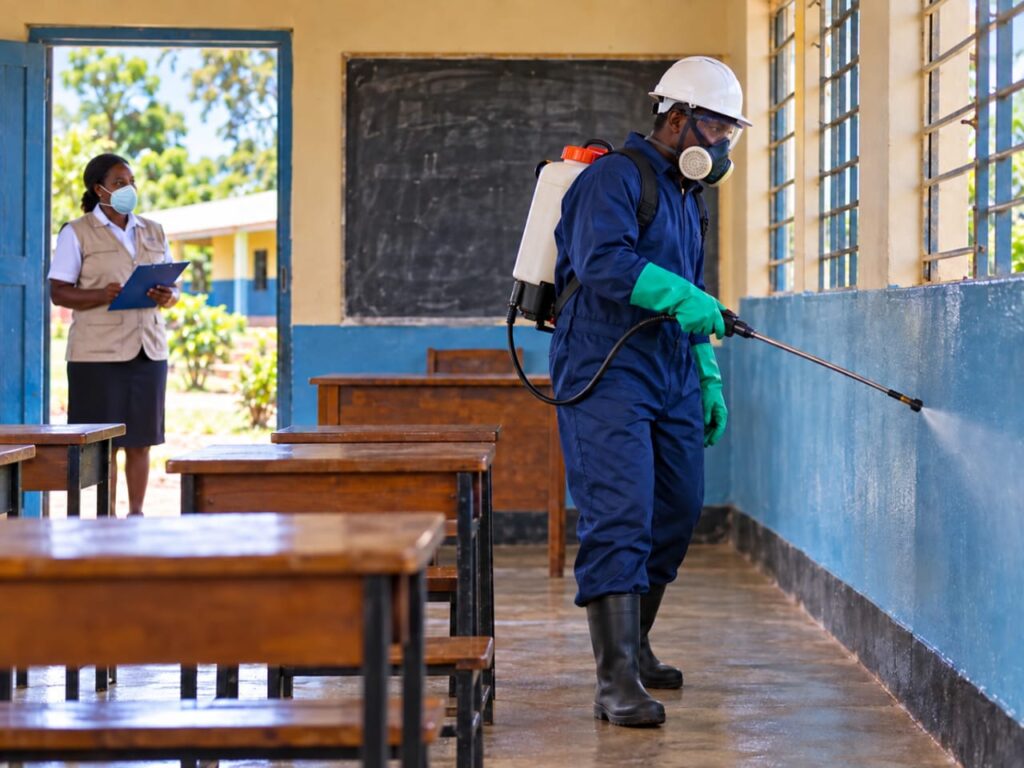
The Safe Schools Indoor Residual Spraying Programme works with health authorities, schools and qualified technical partners to control malaria-carrying mosquitoes in eligible school buildings.
Indoor residual spraying involves applying an approved insecticide to selected indoor walls and surfaces where mosquitoes are likely to rest. When properly planned and conducted, it can help reduce the number and lifespan of malaria-carrying mosquitoes.
CVAMU does not conduct spraying independently. Technical assessments, insecticide selection and spraying are undertaken by authorised professionals following national standards and public health guidance.
The programme aims to:
✅ Reduce contact between children and malaria-carrying mosquitoes in eligible school environments.
✅ Support schools to strengthen malaria prevention.
✅ Promote safe and professionally managed mosquito-control practices.
✅ Improve understanding of indoor residual spraying among teachers, parents and students.
✅ Connect schools with health authorities and technical partners.
✅ Monitor programme implementation, safety and quality.
Before spraying, participating schools undergo a technical assessment. The programme then supports:
✅ Consultation with health and education authorities
✅Assessment of eligible school buildings
✅ Selection of an approved insecticide by responsible authorities
✅ Engagement with school leaders, teachers and parents
✅Preparation of classrooms and other eligible spaces
✅ Spraying by trained and properly equipped personnel
✅ Safe handling of insecticides, equipment and waste
✅ Monitoring and community feedback after spraying
Children do not participate in spraying, handle insecticides or enter treatment areas during application.
Spraying is scheduled to minimise disruption to learning. Treated buildings remain closed for the required period and are reopened only when the authorised technical team confirms that it is safe.
Schools receive clear instructions on preparing rooms, protecting food and learning materials, observing safe re-entry periods and reporting health or safety concerns.
Indoor residual spraying does not replace other important malaria measures. Children and families should continue to:
✅ Sleep under insecticide-treated mosquito nets.
✅ Tell a trusted adult immediately when they have a fever or feel unwell.
✅ Seek testing from a qualified health provider.
✅ Use malaria medicines only as directed by a qualified health worker.
✅ Complete prescribed treatment.
A student or student group may be assigned a tree to care for under adult supervision.
© 2026 All rights reserved Childrens’s Voices Against Malaria